
The Vacation You Keep Skipping Is Costing You More Than the Vacation Would
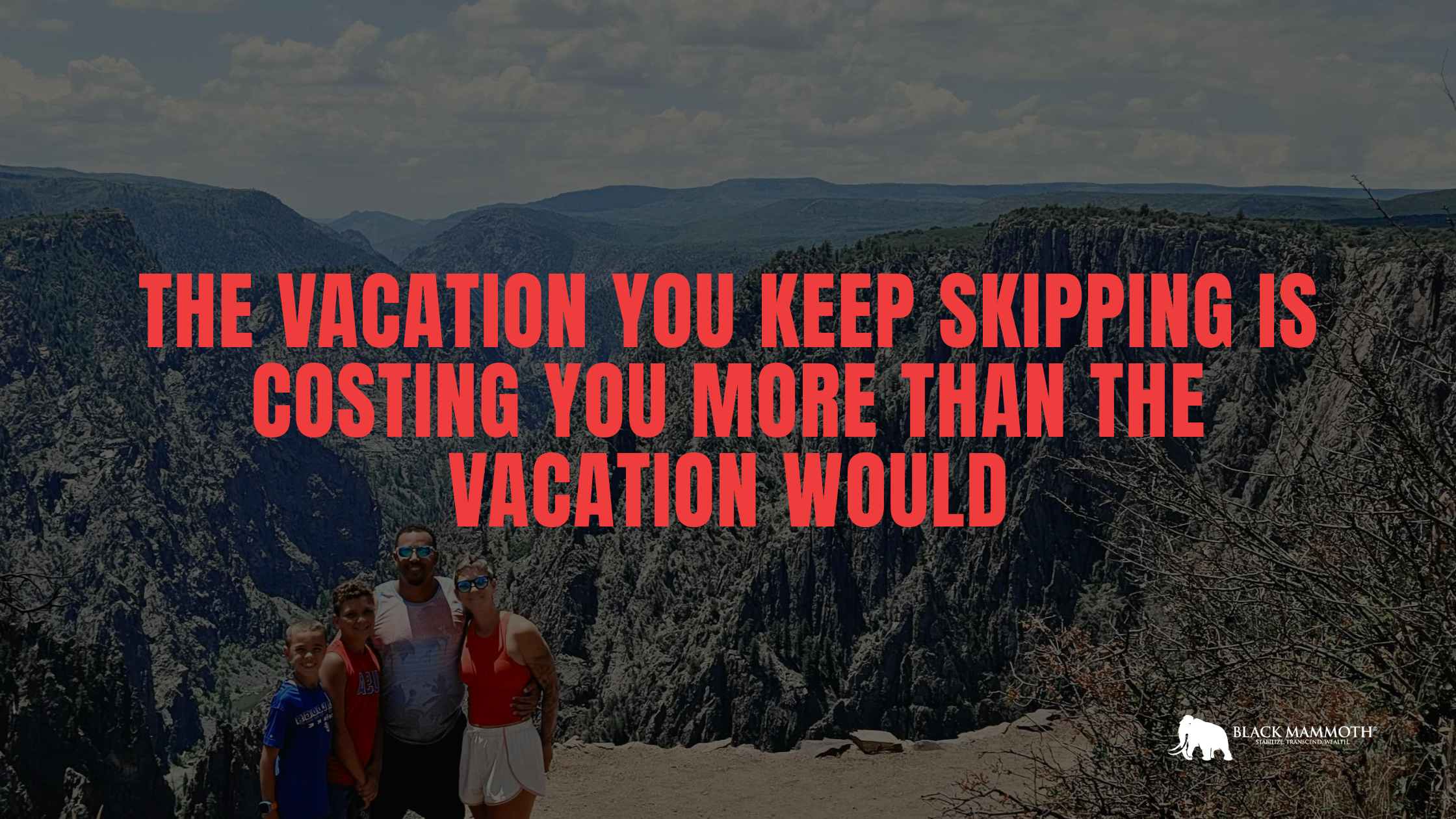
Every summer I watch business owners do the same thing.
They tell their kids "maybe next year." They tell their spouse "once things slow down." They tell themselves they can't afford to leave the business for a week — that the whole thing will fall apart the second they stop answering the phone.
And every summer I have to tell them the same hard truth: the vacation isn't the expensive part. Skipping it is.
I've built a firm, I'm raising two boys with my wife Michelle, and I've sat across the kitchen table from hundreds of families who traded their best years for a business that was supposed to give them freedom and instead quietly took it. So let me say the thing nobody in your networking group will say out loud.
If your business can't survive you taking a week off, you don't own a business. You own a job that owns you.
You Are Not the Exception. You Are the Statistic.
I know what you're thinking. "Stoy, my business is different. My situation is different." Let me show you how not-different you are.
A survey of 600 business owners by Clarify Capital found that nearly half of them work during their supposed vacations, and a full 72 percent skip vacations altogether because of financial concerns. One in four avoid time off out of guilt. One in five stay chained to the desk out of fear the business will fail without them.
It gets worse. OnDeck found that 61 percent of small business owners take just five days off per year — half of what the average American employee takes. Gallup reported that one in five microbusiness owners took zero vacation days in an entire twelve-month stretch. And Xero found that 85 percent of owners admit to working while "on vacation," with 60 percent checking in at least once a day.
So when you tell yourself you're the special case who genuinely can't get away, understand that you are describing the single most common condition in American small business. The trap you're in is the default setting. Almost everybody who owns what you own feels exactly what you feel. That's not a reason to accept it. It's a reason to take it seriously, because a problem this widespread doesn't fix itself.
The Real Math of the Skipped Vacation
Let's do what I always do. Run the numbers.
The trip you keep putting off might cost you $4,000. Uncomfortable, sure. But that's only one side of the ledger, and it's the side that shows up on a bank statement. The other side never does.
There's the cost of a marriage running on fumes because you haven't had two uninterrupted days together in three years. The cost of kids who learn, by watching you, that work is the thing you sacrifice everything else for. The cost of a nervous system stuck in fifth gear until it finally does what over-revved engines do — it breaks, usually at the worst possible time and in a way that costs a lot more than $4,000 to fix.
And here's the part that should really get your attention as a business owner: skipping the vacation doesn't even make you better at the business. The research runs hard in the other direction. A study by Alertness Solutions found that people's reaction times improved by 40 percent after a vacation. The American Psychological Association's Work and Well-Being survey found that after time off, 58 percent of workers reported being more productive and 55 percent said their work quality improved. Meanwhile the National Bureau of Economic Research has documented that the average American workday has gotten nearly an hour longer — and all those extra hours are not producing better businesses. They're producing more burned-out owners.
You can measure the price of the vacation. You can't easily measure the price of the sharper, calmer, more creative version of you that shows up after one. But your business feels the absence of that person every single day, and it compounds — the same way money compounds, just in the wrong direction.
What a Vacation Actually Tests in Your Business
Here's what most owners never think about. A vacation isn't just a break. It's a stress test.
When you leave for a week, you find out the truth about what you've built. Does your team know how to make a decision without you? Do your systems actually run, or are you the system? Is there a second string, or are you the entire roster?
I built Black Mammoth like a team on purpose, because I refused to build a business that collapsed the moment I stepped away. If I'm the only one who can do the important things, I didn't build a company — I built a hostage situation, and I'm the hostage. So is my family.
Your vacation will tell you which one you've got. If everything falls apart while you're gone, that's not proof you should never leave. That's the most valuable piece of business intelligence you'll get all year. It's a map of every single-point-of-failure in your company, drawn for free while you sit on a beach. Most owners pay consultants good money for a worse version of that report. You can get the real one by booking a flight.
The Family Part Nobody Puts on the Balance Sheet
You started the business for them. Remember that?
Somewhere in the founding story is a version of you that said "I'm doing this so my family can have a better life." Then the business got its hooks in, and the family slowly became the thing that gets what's left over — the tired version of you at 8 p.m., the half-present dinner where you're physically at the table but mentally still on the invoice that didn't clear.
Kids don't remember the revenue. They remember whether you were there. They remember the trip where you actually put the phone in the glovebox and got in the water with them. Those memories are a real part of the return on the business you're building, and you cannot buy them back later at any price. The window closes on its own schedule. My boys, Lincoln and Croix, are the ages they are right now for exactly one summer. Same as yours.
This is why I push the families I work with to stop treating time together as the reward they'll finally claim after the wealth is built. It isn't the reward. It's part of the wealth itself. Put it on the balance sheet, because it belongs there — and because a plan that builds money while quietly bankrupting your relationships is not a plan that's working, no matter what the account balances say.
What This Actually Looks Like This Summer
Enough philosophy. Here's the playbook.
Pick the dates first, before you feel ready — because you will never feel ready. There is no version of running a business where a calm, obvious window opens up and says "now is a great time to leave." Put the dates on the calendar as a non-negotiable, the same way you'd treat your biggest client's hard deadline.
Then work backward. Write down every task that only you can do, and over the next few weeks, hand each one to a person or a system. That list is your delegation plan, and building it makes your business more valuable and more durable whether you take the trip or not. You're not preparing to disappear. You're building the thing that lets the company breathe without you.
Set the financial side up so the trip isn't a gut punch. Fund it from a specific savings bucket you filled on purpose, not a panicked swipe you'll feel in September. A vacation you planned and funded is rest. A vacation you charged in a panic is just deferred stress wearing sunscreen. Same beach, completely different nervous system.
And set one real boundary with the business while you're gone. One short check-in window a day, or none at all. Tell your team what a "true emergency" actually means so they stop treating every question like one. This matters more than it sounds: the research on why time off fails to recharge people points straight at the phone. Studies on psychological detachment — the work of researchers like Sabine Sonnentag at the University of Mannheim — find that it's the mental disengagement, not the physical distance, that does the healing. A week at the lake with your head still at the office gives you the tan and none of the recovery.
For the Owner Who "Can't Remember the Last Time"
If you read that headline and winced because you genuinely can't remember your last real vacation, I'm talking to you now, specifically.
That's not a badge of honor, no matter how the hustle culture dresses it up. An owner who never steps away isn't disciplined — the data says they're the norm, and usually they've simply lost the ability to see the walls that have closed in around them. The business became a set of walls so gradually that the walls started to feel like the whole world.
Start smaller if a full week feels impossible. Take a long weekend. Prove to yourself the building is still standing on Monday. Encouragingly, the research says even short breaks deliver real recovery — the Conservation of Resources work by Hobfoll and Shirom found meaningful benefits from time off, while noting the deepest "regathering" of your depleted mental resources takes about two weeks. So start with the long weekend, feel the difference, then build toward the real thing. You're not just resting. You're retraining yourself, and your business, to believe you're allowed to.
The Business Should Fund the Life, Not Replace It
The vacation you keep skipping isn't a luxury you can't afford. The data makes the real math clear: it's a stress test your business needs, a productivity investment that pays you back sharper than you left, a boundary your family deserves, and a piece of the wealth you started building in the first place.
Take the trip. Build the systems that let you take it. Put the dates on the calendar before you feel ready, because "ready" is a lie that will quietly cost you a decade of summers you can never get back.
Your business is supposed to fund the life you actually want — not become the thing standing between you and it. If yours has quietly crossed that line, that's exactly the conversation we're built to have. That's what a Modern Family Office is for: making sure the money, the business, and the life are all pulling in the same direction instead of fighting each other.
Schedule a Power Hour with Black Mammoth. Then go get in the water with your kids. The business will be there when you get back — and if we've done our work right, it'll be stronger for the fact that you left.