
What a Torn Achilles, a Drake Jersey, and 94% of Women in the C-Suite Have in Common
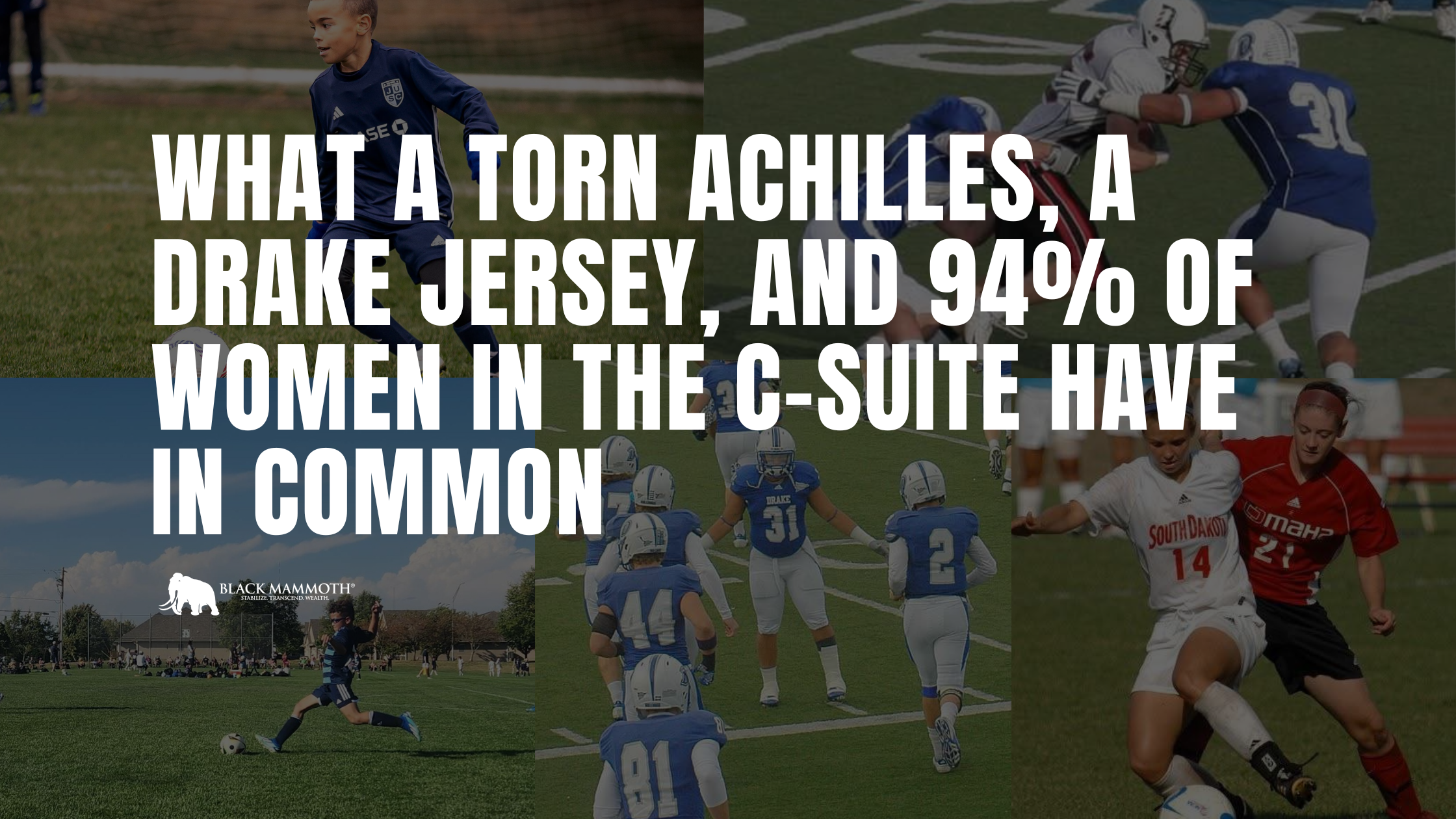
Two weeks before what was supposed to be my last season at Drake University, I tore my Achilles.
Not in a game. Not under stadium lights. In a practice rep that didn't matter to anyone but me. Four years of letter-winning. Four years of wearing number 31. Four years of buying into the idea that the work would be rewarded with a final season I could close out on my own terms. Gone. Just like that.
I'm telling you this not because I want sympathy. I'm telling you because that moment — and the four years that built up to it — created the human you're hearing from right now. The CEO. The Certified Financial Planner. The husband. The father of two boys who watch me try to lead my own life every day. Everything I do at Black Mammoth — every client conversation, every uncomfortable truth I have to deliver, every system I build for a business owner trying to stop drowning — traces back to a locker room in Des Moines.
And the more I've watched the world of business, leadership, hiring, and money up close, the more convinced I've become that the athlete in the room is almost always the person you should be listening to. Not because they were great at sports. Because of who sport made them when they weren't looking.
Let me show you what I mean.
The Research Isn't Cute. It's Damning.
You don't have to take my word for it. The numbers are loud.
EY partnered with espnW on a study of 400 women executives across the globe. Half of them were sitting in C-suite seats — CEO, CFO, COO, board director. The other half were in senior management. What they found was uncomfortable for anyone who's ever rolled their eyes at the "dumb jock" stereotype: ninety-four percent of those C-suite women had participated in sports at some point in their lives, and fifty-two percent had competed at the collegiate level. Seventy-four percent of them said directly that a background in sport accelerates a woman's leadership and career potential.
Deloitte ran their own version of this in 2023. Eighty-five percent of women who played sports said the skills they built on the field, court, or pool deck were important to their professional success. Among women who'd actually climbed into leadership roles, that number jumped to ninety-one percent.
A study published in the Journal of Leadership & Organizational Studies tracked men who'd played varsity-level high school sports decades earlier. They were demonstrating higher levels of leadership and holding higher-status careers than their non-athlete peers. Decades. Not months. Not years. Decades.
And it's not just the soft stuff. Researchers have found that Division I athletes are flat-out better at thinking quickly under pressure than college students who don't compete. Which makes sense. When you've been on the wrong side of a third-and-long with thousands of people screaming at you, a Tuesday morning Zoom with a difficult client doesn't rattle you the same way it rattles someone who's never had their composure publicly tested.
So when I tell you to look for the athlete in the room, I'm not being sentimental. I'm pointing you toward a pattern the data has been screaming about for over a decade. If you want to know who's most likely to lead well, hire well, build well, and advise you well — start there.
Drake, Number 31, and the Best Education I Ever Got
Before Black Mammoth, before Kālā Capital, before Legacy Fiduciary Services, before I had the letters CFP after my name, I was a kid from Omaha who got a chance to play Division I football for the Drake Bulldogs.
I started as an accounting major because I thought I was supposed to. I figured numbers were numbers, and if I was going to spend my life chasing financial freedom, I'd better learn the language of the people who counted the money. Took me about a semester to figure out accounting wasn't my game. Switched to finance, picked up a minor in business law and insurance, and stayed for the long haul.
But the real classroom for me was the locker room.
I wasn't the most talented kid on the field. I'll tell you that to your face. What I learned at Drake, though, you can't get from a textbook, a TED talk, or a LinkedIn course: you don't get to choose when the work shows up. You only get to choose whether you do it. Practice on a Tuesday in February when nobody's watching is the same practice that decides whether you make the play in October when everyone is. Conditioning when your lungs are on fire is the same conditioning that decides if you're still standing in the fourth quarter. Showing up to the film room when your body hurts is the same discipline that decides if your teammates trust you in the huddle.
That's the lesson. Not "work hard." Anyone can say that. The lesson is that the work is invisible right up until the moment it isn't, and by then it's too late to start.
Then the Achilles. Two weeks out from my senior season. I never got to write my own ending. I had to watch a team I'd bled for go play without me. And I had to learn, at twenty-two years old, how to grieve a chapter I didn't get to close. That's a different kind of education than the one Drake printed on my diploma. That one taught me that no matter how disciplined you are, no matter how much you sacrifice, life can take the script and tear it up in front of your face. The only thing left for you to control is what you build next.
That's the kid who started Black Mammoth. Not an All-American, because I wasn't one. A four-year letter winner who got cut off at the knees and had to figure out who he was without the jersey.
What That Made Me as a Business Owner
When I built Black Mammoth, I didn't build it like a financial firm. I built it like a team. Roles. Accountability. People who can run their own routes and trust the person next to them to run theirs. A culture where you're allowed to lose a play but you're not allowed to quit on the next one. A bench deep enough that if I went down — really went down — the firm could keep moving for our clients. Because if I ever stepped away for a week and the whole thing collapsed, I didn't build a business. I built a hostage situation. And I refuse to do that to my family or to the people who trust me with theirs.
Every small business owner reading this is asking themselves the same questions, whether they realize it or not. Can your business survive your absence? Do you have a real second string, or are you the entire roster? Are you the coach, or are you trying to be the coach and the quarterback and the kicker and the trainer all at the same time?
That mindset — building like a team — is athlete DNA. It's the reason so many founders who played at a high level can take a small thing and turn it into something durable. They've been trained to think in systems, in roles, in mutual accountability, in long seasons instead of single-game heroics.
And here's the part I don't say out loud often enough
Black Mammoth is a family affair. Michelle, my wife, played Division I soccer at the University of South Dakota. She joined the firm last year, which means the same backbone that carried her through four years of college soccer is now sitting across the table from our clients right next to mine. Two athletes building one firm. Our boys, Lincoln and Croix, are young athletes themselves — not because we're chasing scholarships, but because we want them in environments that teach them what sport taught us. How to compete. How to lose. How to show up when it's hard. How to be a teammate before you ever try to be a star. That's the mindset we run our home on. It's the same mindset we run this firm on.
What This Means for Hiring (and for Being Hired)
If you're an employer, take this for free. When you're sitting across from a candidate and you see "Division I athlete" or even "four-year varsity" on the resume, slow down. Do not skim past it. That line means this person has voluntarily lived inside a system of accountability most adults never experience. They got coached hard. They got benched. They got back up. They balanced twenty-plus hours a week of sport with a full course load and a life. They learned to take feedback that would devastate the average professional and translate it into performance the next day.
You're not hiring an athlete. You're hiring someone who's already built the muscle of doing hard things in public.
And if you're the candidate — the former athlete reading this who's wondering how the hell to translate four years of football, basketball, soccer, swimming, track, or anything else into a job interview — listen to me. Stop apologizing for it. Stop minimizing it. The skills you built showing up to five a.m. lifts, hitting your marks in film study, holding teammates accountable when nobody else would, and competing in front of crowds that wanted you to fail are the exact skills that build careers. You just have to learn to talk about them in language that translates outside the locker room.
That's part of what a real advisor — a real planner, a real coach in your professional corner — should be helping you do. Helping you see what you've actually built. Helping you stop selling yourself short.
How This Applies to Choosing the People Who Touch Your Money and Your Family
This part matters most. Stay with me.
You are going to hire a lot of professionals over the course of your life. A financial planner. A CPA. An attorney. A doctor. An insurance agent. A wealth advisor. The people who, quietly, decide a huge portion of your family's future. Most of you are picking those people the wrong way. You're picking them based on who showed up in a Google search, who your buddy from work uses, or who has the prettiest office on the nicest floor of the nicest building.
Let me give you a different filter. Ask them what hard thing they've been through and how they came out of it.
I'm not saying every great advisor has to be a former athlete. I'm saying every great advisor has to have been forged somewhere. Sport is one of the cleanest crucibles we've got — you fail in public, you get coached publicly, you get measured publicly, and you have to keep showing up. When you sit down with someone who's been through that, or some equivalent version of it, you can feel the difference. They don't flinch when the hard conversation comes. They don't sugarcoat. They tell you the truth about your retirement plan, your tax exposure, your business structure, the way your marriage is showing up in your money. Because they've already lived through environments where soft truths get you destroyed.
You want someone in your corner who treats your family like a teammate, not a transaction. Someone who'll hold you accountable to your own goals the way a good coach used to. Someone who won't blink when life punches you in the mouth — because they've already been there themselves and they've already gotten back up.
That's what we built Black Mammoth to be.
The Bottom Line
You don't have to have played a sport to lead well, run a business well, get hired into a great role, or pick the right people to walk alongside your family. But the data, my own experience, and the experience of damn near every great operator I know all point in the same direction. Athletes — real ones, who got humbled and coached and built by their sport — show up differently. They lead differently. They hire differently. They advise differently. They sit on the other side of your kitchen table differently.
If you've been one, own it. Build on it. Stop hiding it.
If you're hiring one, listen to them.
And if you're choosing who's going to walk alongside your family for the next twenty years — your planner, your CPA, your wealth advisor — find the person whose backbone was built somewhere real. Then let them go to work for you.
If you're ready to have that conversation, schedule a Power Hour with Black Mammoth Let's talk about what's actually standing between your family and the life you want. I've already done the conditioning.